Running a Life Is a 24/7 Job. Fairness, workload, and the space we need to feel alive again.
Why Fairness at Home Has Nothing to Do With the Dishwasher. How to design a life and workload that feels fair for both partners — and creates space to live.
Sometimes in the evening, after a completely normal Tuesday, you sit down for a moment and think: What actually happened today? You were busy the entire time.
Up before everyone. Coffee. Dishwasher.
Breakfast logistics. Lunch boxes. School bags. The forgotten school form.
Then it happens. The wrong shoes. Or the wrong shirt. Not slightly wrong. Catastrophically wrong.
The pink rain boots on a hot August day. Or the shirt. Apparently the only acceptable shirt today is the one currently somewhere in the laundry universe. We look for it. We do not find it. And suddenly we are having a full existential crisis about clothing before 7:00 a.m. Someone is crying. Someone is negotiating. Someone is explaining why the blue shirt and the other blue shirt are absolutely not the same thing. Eventually we leave the house.
School drop-off. Everyone survived so far… Barely. Back home. Or to the office. Work starts. Emails. Calls. Messages from school. A calendar reminder for the dentist. Quick grocery run. Laundry in. Laundry out. Laundry forgotten. Laundry back in again. Dinner planning already running in the background.
Afternoon. Pick-up. Snacks. Homework questions. Transport to activities. Transport back from activities. Someone is tired. Someone is hungry. Someone suddenly remembers the project due tomorrow.
Evening. Kitchen. Dishwasher. Cooking. Setting the table.
The door opens. Your partner comes home. He had a long day too. On the way home he might be picturing the evening. Home. Dinner. Happy kids. Relaxed wife. A cozy family moment. He walks in. And meets… one child crying. one child fighting with a sibling. A kitchen that has already been used three times today. And a wife who looks like she has been running a small logistics company since 6:00 a.m.
Dinner exists. Technically. But the atmosphere is… dynamic.
Dinner. Kitchen.
Bedtime begins. Bedtime negotiations. Pyjamas. Tooth brushing. All children. In a row. One can’t find the right pyjamas. One suddenly remembers the missing homework sheet.
Reading. Just one more chapter.
Water. Another water. One more hug. One more question about dinosaurs.
Kitchen again. A quick breakfast prep for tomorrow. Lunch boxes. Tumble dryer.
And you are completely done. Not “a little tired.” Done.
And at the end of a completely normal Tuesday, it’s surprisingly hard to say what exactly you did all day.
You were busy the entire time. Running. Solving problems. Organizing life. And yet… nothing feels very visible. No big milestone. No finished project. No clear result you can point to. Just the quiet feeling of being completely done.
And that raises an interesting question. What exactly is all this work?
FAIR PLAY
Recently I came across the Fair Play card game by Eve Rodsky. Maybe you’ve seen it. Here you can find more about it: https://www.fairplaylife.com

It’s a deck of cards where each card represents one responsibility that keeps a household running. Things like groceries. Laundry. Doctor appointments. Planning vacations.
Seeing those cards was a bit of a moment.
Because suddenly all those small invisible tasks become visible. That inspired me to do something simple. I started writing my own list. Not just the obvious chores. Everything.
And because I really wanted it to be complete, I even asked ChatGPT to help me think of everything I might be forgetting. Which, as it turns out, is quite a lot. School communication. Meal planning. Birthday gifts. Doctor appointments. Vacation planning. Laundry. Homework supervision. Replacing the toothpaste. Finding the missing sports shirt.
The list passed fifty tasks very quickly. Then one hundred. It ended somewhere around 200 tasks. And that’s before you even count all the little sub-tasks hidden inside them. Daily things. Weekly things. Seasonal things. And the constant background work of remembering, planning, anticipating.
That was the moment something became very clear:
Running a life is not a small list of chores. It is a complex operating system. And much of it exists entirely inside someone’s head.
And once you start seeing it that way, a few common myths about fairness suddenly become visible.
The Equality Myths
Now here is the interesting part. Most couples genuinely want a fair partnership. Most men don’t wake up in the morning thinking: “How can I make my partner carry the entire household today?” And most women don’t want to run the whole system alone either.
So why does this imbalance happen so often? Part of the reason lies in a few very persistent myths about fairness.
Myth 1 _ Fairness means splitting chores.
You cook. I clean. You do laundry. I take out the trash.
Sounds fair. But this is not actually how fairness works.
Because the visible chores are only a small part of the system. Behind every task there is a lot of invisible work. What actually matters is the total workload.
Noticing that groceries are running out. Planning meals. Checking the school calendar. Remembering the birthday party on Saturday. Making the dentist appointment.
The thinking work. The planning. The monitoring.
When one person carries most of that invisible layer, the system becomes exhausting — even if the chores look evenly divided.
Fairness emerges when the overall burden of work and responsibility feels balanced, not when the visible chores are divided.
Myth 2 _ Whoever works fewer hours should do the housework.
At first glance, this idea makes perfect sense. If one partner works fewer hours in paid work, it seems fair that they take on more at home. And sometimes that works.
But his principle often becomes distorted in practice.
When women reduce paid work hours — often after children are born — they typically take on more than the proportional share of domestic work. They gradually become the manager of the entire life system.
Not just the cooking. But the meal planning. Not just the laundry. But noticing when children need new clothes. Not just the dentist visit. But remembering to make the appointment in the first place. And then remembering again six months later.
Appointments. School communication. Birthdays. Clothes. Doctor visits. Holiday planning.
The visible work. And the invisible work behind it. The planning. The remembering. The anticipating.
And because much of that work happens quietly in someone’s head, it often goes unnoticed.
Until one person starts feeling permanently responsible for keeping the whole system running.
Myth 3 _ The problem is the chores.
Many couples think the argument is about who empties the dishwasher or does the laundry. It rarely is.
The real issue usually sits somewhere else.
In the constant background work of remembering, anticipating, coordinating. Anticipating needs, remembering schedules, planning meals, monitoring school communication, coordinating appointments, organizing holidays and birthdays…
The feeling of being the person who always has the whole system in their head. And when one person holds the whole system in their head, even a seemingly equal division of chores can still feel exhausting.
Myth 4 _ The Fairness Problem Is About Effort
In many conversations about household labor, couples argue about effort.
“I work really hard.” “But I also work hard.”
The conflict often becomes a comparison of who is trying or working harder. Or is more exhausted or tired.
But the key variable in perceived fairness is actually discretionary time — the amount of time each person has left for rest, hobbies, or recovery.
When one partner consistently has less rest, less sleep, and less time for themselves, the system begins to feel unfair regardless of how much effort both people invest.
Equalizing free time and recovery time is often a more powerful predictor of fairness than dividing tasks evenly.
So if splitting chores isn't the real solution, what actually creates fairness?
How is fairness actually created?
This is the encouraging part.
Fairness in a household rarely comes from perfectly splitting every chore. Life is simply too messy for that.
What actually creates the feeling of fairness is something else. Three things matter much more:
1. The invisible work has to become visible.
You cannot share what nobody sees. Many of the most exhausting tasks in family life are not the visible ones. It’s the background work.
Remembering the dentist appointment.
Tracking school emails.
Planning the meals.
Knowing when the toothpaste runs out.
Once couples start mapping these invisible tasks, something interesting often happens. Both people realize: This system is much bigger than we thought. And that alone already changes the conversation. Because suddenly the problem is not “who does more.”
The problem shifts to: How do we run and own this system together?
2. Ownership works better than “helping.”
Another interesting insight. Helping is nice. But helping still means someone else remains responsible.
Someone still has to notice the problem. Ask for help. Explain what needs to be done.
True fairness works differently. Instead of helping, tasks have clear ownership:
+ One person owns the dentist appointments.
+ One person owns the groceries.
+ One person owns the school communication.
From noticing the task to planning it to getting it done. This removes a huge amount of hidden mental load.
A small tool that can help - The Fair Play Game
Remember the Fair Play card game I mentioned earlier? The idea behind it is beautifully simple.
Each card represents one responsibility that keeps a household running.
Groceries. Laundry. Doctor appointments. Holiday planning.
When couples actually put these cards on the table, something interesting happens. The invisible work suddenly becomes visible. Tasks that used to live quietly inside someone’s head now exist out in the open. And once you can see the system, you can start having a very different conversation.
Not: "Who helps more?" But: "How do we want to run this system together?"
A good life is not just about keeping the system running. It’s about making sure the people inside that system get to live inside it fully.
And here comes the most important one:
3. Fairness is felt in time and energy — not in chore counts.
Fairness in a household rarely comes from splitting chores perfectly. Life simply doesn’t work like that. One couple might divide tasks 50/50. Another couple might divide them very differently. Both arrangements can feel fair.
What really matters is something simpler.
The total workload of life — measured in hours:
Paid work.
Household work.
Care work.
Planning work.
All of it counts.
Both partners’ time is measured the same.
Both partners’ time has the same value.
Every hour of life counts the same — no matter where the work happens.
And the real question underneath it all is this: Do both people feel that the overall load of life is shared?
Because working outside the home for many hours is real work. But so is running the entire system at home. And by the evening, very often both partners are tired.
Unfairness is often felt in moments like this:
One person sits down on the couch. The other still keeps the system running. Kitchen. School bags for tomorrow. A quick breakfast prep. The last laundry cycle.
Not because one person has more energy. But because one person is still on duty.
Fairness is not about identical tasks. It’s about whether both people eventually get to step out of responsibility: To rest. To breathe. To be off duty for a while.
When one person remains the default manager of the system even after both are exhausted, the balance slowly starts to feel unfair. Because fairness is not about perfectly dividing chores.
It’s about creating a life where both people have room to live, grow, and breathe.
And this is where the real shift can happen.
Because the conversation changes.
Couples often get stuck in low-quality questions. Questions like:
Who emptied the dishwasher?
Who took out the trash?
Who did more today?
Those questions lead nowhere. They keep everyone focused on tiny pieces of the system.
Let’s look at this closer:
The real shift - From Low-Quality Problems to High-Quality Questions
Most of the conversations couples have about household work are actually low-quality problems.
HOW we ask questions or phrase our problems, shape the answers we get. Low-quality questions tend to sound like this:
- Who did more today?
- Why do I always have to do everything?
- Why didn’t you empty the dishwasher?
- Why didn’t you notice the school email?
These questions may feel justified. And they are often technically answerable.
Yes, someone forgot the dishwasher.
Yes, someone missed the email.
But answering these questions rarely changes the system. They keep us focused on tiny events from yesterday. And tiny events from yesterday rarely reveal how to build a better tomorrow.
Low-quality questions keep us stuck in small conflicts.
High-quality questions give us room to design something better.
High-quality problems sound different. High-quality questions work differently. They shift the conversation from blame to design. From past mistakes to future structure.
They move us away from questions like: Who forgot the laundry? "Who emptied the dishwasher?"
toward something far more meaningful:
"Do we both get to rest?"
"Do we both have time for things that refill us?"
A walk or workout.
A hobby.
An evening with friends.
Twenty quiet minutes with a book.
When the system works well, both eventually get to step out of responsibility. Both get moments where they are not the manager of life.
And when we start asking higher-quality questions, something interesting often appears. The conversation slowly moves beyond chores and tasks. It becomes a conversation about life.
It turns out the dishwasher was never the real problem.
The real question is: What kind of life are we actually creating inside this system?
Because we are more than the roles we currently hold. Mother. Father. Husband. Wife. Breadwinner. Household manager.
These roles are real, important and meaningful. Yet they are not our full self. Just parts of us.
We are also the selves we once were.
The ambitious student. The young professional. The art lover. The basketball player. The cheerful friend. The late-night talker. The spontaneous one. The woman with big plans. The one who stayed out late and laughed loud. The one who could disappear into a book for hours. The woman who had time to become whoever she wanted to be.
Many of those parts don’t disappear when life becomes full. They simply become very quiet.
Hidden somewhere under responsibilities, logistics, school emails, dinner planning, and the constant background noise of everyday life.
And if they stay quiet for too long, something inside us starts to feel strangely absent.
And we are also someone who is still becoming.
Especially after big life shifts. After children arrive. After careers change. After someone steps away from paid work for a while.
Human beings are designed to evolve. To contribute. To grow. To create. To be seen. To connect with others. To explore who we might become next.
But when life becomes too tightly packed with responsibilities, there is simply no space left for that part of being human.
No space to think.
No space to try something new.
No space to follow curiosity.
No space to become.
And then something happens inside us. We start to feel tired in a way that sleep does not fix. Low on energy. A little flat. Not quite alive.
And we wonder why…
The answer is painfully simple.
Life has become so full that we are no longer really living inside it. We are just managing it. We can hardly hear ourselves in it anymore. And at this point something quietly appears.
Questions…
Who am I now?
What gives me energy?
What makes me feel alive?
What do I want to grow into next?
These questions point to something deeper. Our wants. Our desires.
And the quiet fear that appears when those questions begin to whisper. Because the answers might not be convenient.They might require change. And life already feels very full. We are exhausted. Low on energy. The last thing we want is another big task. And these questions can feel exactly like that. A very big task.
So we push the questions aside. But they tend to return. Quietly. Persistently.
You do not have to figure these questions out alone. This is often the moment when a good coach becomes incredibly helpful. Not to tell you what to do. But to think with you. To make it feel safe to listen to the quiet voices inside. To discover what you might want. What you may have been too afraid to dream or desire.
So. Fairness in a household is not only about chores. Those parts of a person also need space.
It’s about whether both partners still have room to be a Self inside their life.
That’s when fairness can start to be felt. Not because every chore was perfectly divided. But because both people get to really LIVE inside the life they are building together.
If you want to explore this further - Download my Workbook “Stop Functioning. Start Living. The Reset” and the complete Task List
Sometimes the first step toward change is simply seeing the system more clearly. That’s why I created a simple resource inspired by the Fair Play concept. It’s a small workbook with exercises and reflection prompts.
Along with it comes an Excel sheet containing a list of around 200 tasks + subtasks that quietly keep a life running. You can modify and adapt the list to fit your own life and family system.
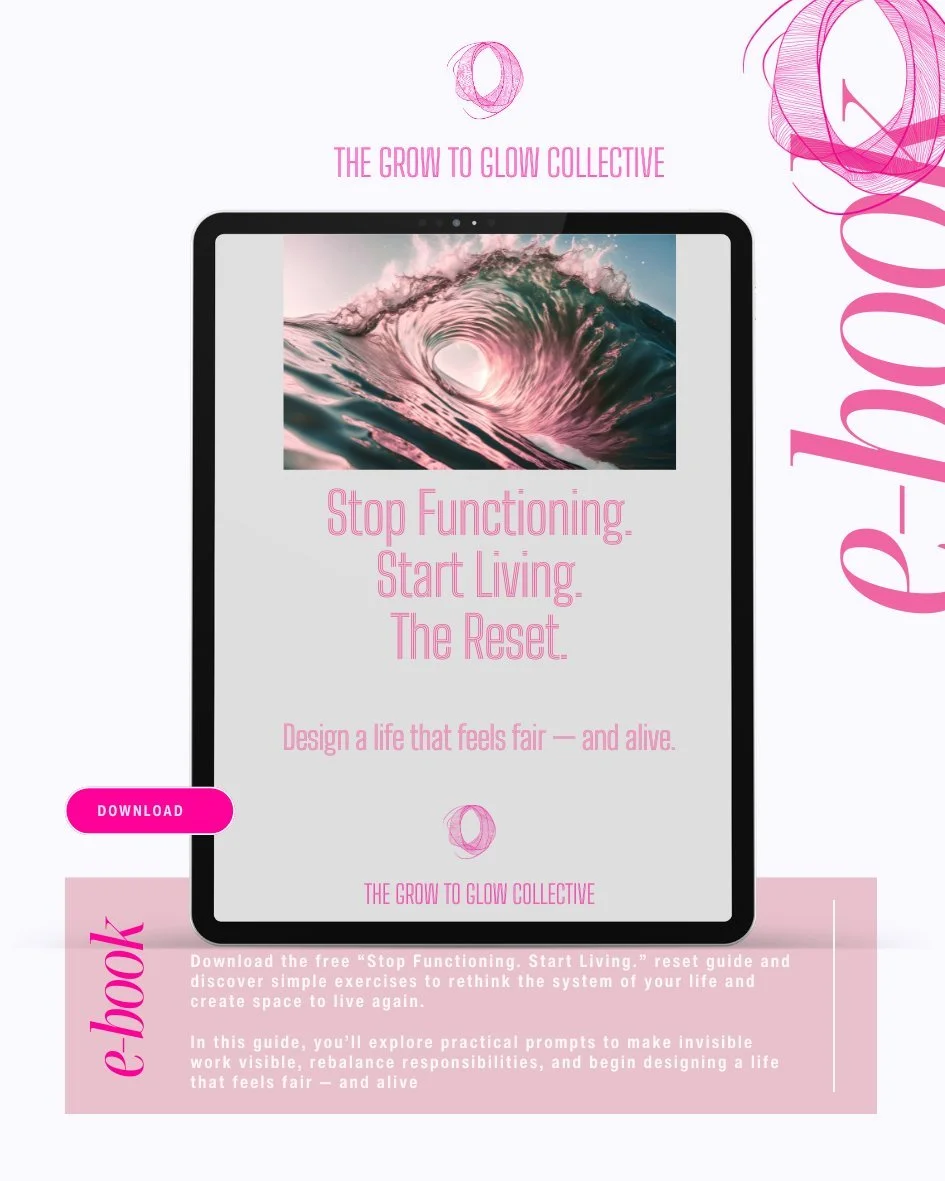
Download the free “Stop Functioning. Start Living.” reset guide and learn how to redesign the system of your life so it feels fairer, lighter, and more alive.
Inside, you’ll find powerful exercises to uncover invisible work, rethink responsibilities, and take the first small step toward a life that works for you too.
The list includes all tasks and subtasks. Daily things.Weekly things. Seasonal things. And the many small responsibilities that usually live only inside someone’s head. Seeing them written down can be surprisingly powerful.
It works for many different life models: Double income or single income. No kids or many kids.
Men, women, couples. Married or not. Because the system of everyday life looks different for everyone.
Use it to reflect.
Use it to start a conversation.
Or simply to see your life system with fresh eyes.
And if you want deeper support
Sometimes insight alone already creates change. Sometimes it helps to look at the system together with someone from the outside.
In coaching we explore questions like:
- How do you redesign a life system that feels fair and sustainable?
- How do you reduce invisible overload?
- How do you create more space to rest, grow, and be yourself again?
If you feel curious about that work, you’re very welcome to book a coaching conversation.
And importantly: It does not require two people to start changing a system. Often one person gaining clarity is enough to shift the dynamic.
And when I say that it doesn’t take two people to start changing a system, some people immediately think:
Why me? I’m already doing everything.
And yes. That was me once. I completely get that.
And of course, ideally two people sit down together, look at the system of their life, and redesign it.
That would be wonderful. But waiting for the perfect moment when both people suddenly arrive at the same realization… That’s a bit like waiting for a day when champagne rains from the sky and chocolate has no calories. You might be waiting a very long time. Probably forever.
Sometimes until resentment quietly fills the room. Or until you meet in front of the divorce lawyer.
So:
Who is actually in the best position to change this?
Who better than you?
You already know how the whole thing works. You manage an incredibly complex operation every single day. Schedules. Needs. Logistics. Emotions. You know where the pressure points are. You know where the system works. And where it doesn’t.
So who better than you to start redesigning it?
Not by doing more. But by stopping to run it unconsciously.
You are already doing it.
Now you get to redesign it — consciously and with intention. By deciding that the life you are building should also work for you.
Because waiting until resentment piles up is rarely a great strategy.
And honestly?
Designing a life consciously is actually a pretty powerful position to be in.
Book your discovery call with me because waiting until
it rains champagne and calorie-free chocolate might take a while...
With intention.
Further readings and tools
If you would like to explore these ideas more deeply, the following books and resources offer thoughtful perspectives on relationships, fairness, personal growth, and the invisible work of life.
Eve Rodsky — Fair Play & Fair Play Card Game
A groundbreaking book about the invisible labor that keeps households running and how couples can create a fairer distribution of responsibilities. The Fair Play Card Game is a practical tool based on this concept that helps couples make invisible work visible and assign clear ownership of responsibilities.
Jancee Dunn — How Not to Hate Your Husband After Kids
A funny, honest, and surprisingly insightful look at the real-life challenges couples face after children arrive — and how communication and small structural changes can dramatically improve the partnership.

Eve Rodsky — Fair Play